
Art, Conflict, and Consciousness: Art Basel Qatar 2026 highlights & Why Juan Antonio Guirado Feels Urgently Relevant Today


Why Art That Matters Still Matters: Art Basel Qatar 2026 highlights
By Catalina Guirado
Art Basel has always been a bellwether for where the art world is — and where it’s going. This year, the launch of Art Basel Qatar made headlines not because it was bigger, louder, or more extravagant, but because it foregrounded context-rich, narrative-driven art — work that refuses to sit quietly in the corner.
In my Art Basel Qatar 2026 highlights set across Doha’s Msheireb district, including the M7 and the Doha Design District, the fair presented 84 artists through 87 galleries from around the world. What emerged was not spectacle, but dialogue — international, cultural, and deeply relevant to the moment we are living in.
What struck me most was that political and humanitarian content was not hidden or softened. It was present, visible, and unapologetically part of the conversation.
Conflict, Narrative, and the Art Market
During the opening days, several galleries presented works directly engaging with the ongoing Israel–Palestine conflict — a subject many markets still treat as risky or commercially inconvenient. Whether price tags moved immediately is almost beside the point. The fact that these works were shown at all is telling.
David Zwirner presented works from Marlene Dumas’s Against the Wall series — paintings built from media imagery that confront collective memory and trauma. Rashid Rana’s Black Square (2025) stood out as a powerful photomontage addressing conflict, with proceeds directed toward humanitarian relief.
Beyond the gallery walls, Jenny Holzer’s commanding SONG — projected by drone across the night sky above Doha’s Museum of Islamic Art — merged poetry, language, and lived experience into a contemporary ritual that will continue throughout the fair.
These were not decorative gestures. They were statements.

Why This Matters to Collectors Today
Art that speaks to history, identity, and cultural context is no longer niche — it is becoming central. Collectors in the Gulf, and globally, are increasingly drawn to work that carries meaning beyond aesthetics. They want art that moves them, connects them to global patterns, and holds relevance beyond seasonal market cycles.
This shift mirrors what we have always believed at the Guirado Estate: that art must engage with consciousness, historical awareness, and emotional truth — not simply exist as visual currency.
Guirado in the Moment
In this context, the work of Juan Antonio Guirado feels increasingly urgent.
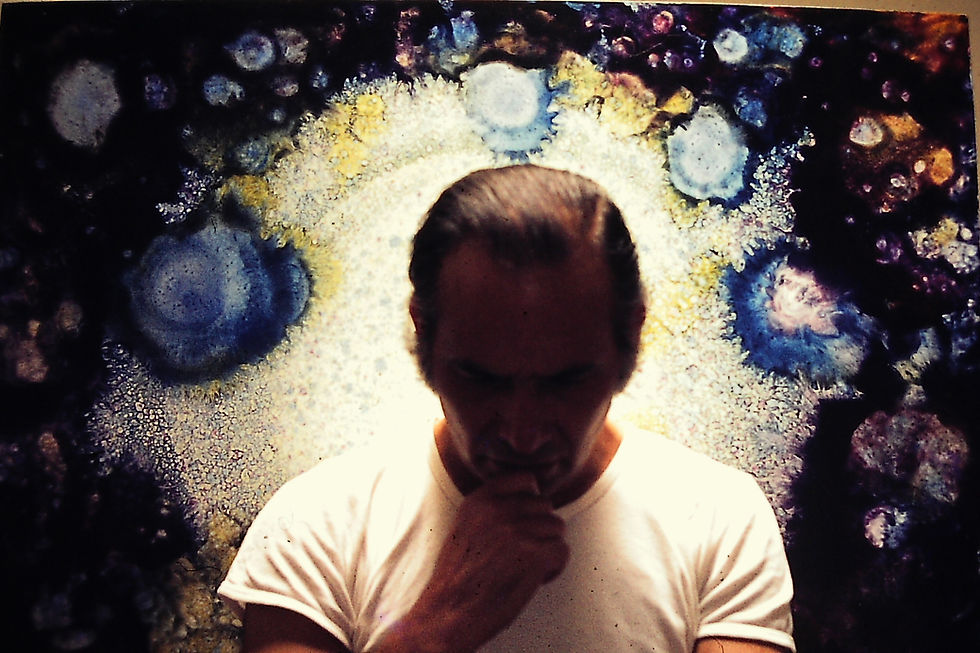
Guirado’s oeuvre — visionary, metaphysical, and deeply engaged with human struggle and spiritual awakening — resonates strongly with the themes now re-emerging in the global art conversation. While artists at Art Basel Qatar were grappling with the realities of today, Guirado anticipated many of these concerns decades earlier.
At the Guirado Estate, we have always believed that art should move, awaken, and unite — not merely decorate. This sensitivity to cultural resonance is where meaningful work finds its true audience: collectors, curators, and institutions who understand that value extends far beyond price.

Art, Humanity, and the Middle East as Symbol
Throughout his career, my father returned repeatedly to the human figure — often fragmented, watchful, or wounded — set within landscapes that feel both sacred and contested. These were never literal depictions of specific events. Rather, they were symbolic meditations on what happens when land, faith, power, and identity collide.
In this sense, his work resonates deeply with the enduring humanitarian realities of regions such as the Middle East, where history remains unresolved and the human cost of division is deeply felt.
Works referencing Palestine and Israel do not seek to simplify or sensationalise conflict. Instead, they present a profoundly humanist meditation on loss, endurance, and the psychological toll of war — positioning Guirado not as a political commentator, but as a moral witness.
What makes this resonance so powerful is that Guirado never chose sides. He chose humanity. His paintings speak to exile rather than territory, to suffering rather than ideology, and to consciousness rather than nationalism. They ask the viewer to witness — not to judge.

A Legacy Recognised, Not Manufactured
During the height of his success in the 1970s and 1980s, Juan Antonio Guirado was collected internationally by figures such as Academy Award–winning director John Schlesinger, author J.D. Salinger, and His Majesty King Hussein of Jordan. His work entered major institutional collections, including the permanent collection of the Museo Reina Sofía in Madrid.
He received the El Grollo d’Oro, awarded as a distinct honour during the 1976 Venice Biennale period, and was later presented with a Lifetime Achievement Award at the Malta Biennale in recognition of his contribution to contemporary art.
Yet like many artists whose work resists easy categorisation, Guirado’s legacy was never driven by market cycles. Today, that independence is precisely what makes it compelling to a new generation of collectors — including figures from the worlds of film, music, and global entrepreneurship — who are seeking art with depth, integrity, and long-term cultural value.

Stewardship and a Living Legacy
Since taking on responsibility for the Estate in 2010, my role has been to protect this integrity while allowing the work to evolve. That has meant careful archiving, scholarly research, museum engagement, and selective reintroduction — never saturation.
It has also meant embracing new forms of expression, from digital and immersive interpretations to design applications, always rooted in the original work.
At the heart of this approach is a belief that art should not be locked away in vaults waiting for the next market cycle. It should live — on walls, in spaces, and within conversations that matter.
This philosophy underpins the Guirado Collector’s Circle, through which a curated selection of original works and limited editions are released directly from the Estate. Each piece is accompanied by full provenance and certification, ensuring transparency while inviting collectors into a living legacy rather than a speculative transaction.
Why This Moment Matters
As global attention shifts toward art that carries conscience and cultural weight, Juan Antonio Guirado’s work stands as a reminder that true relevance is never manufactured. It is revealed over time.
This is not about rediscovery for its own sake.It is about recognition — of an artist whose vision speaks powerfully to our present moment, and whose legacy continues to evolve with purpose, clarity, and heart.
By Catalina Guirado


Comments