
Juan Antonio Guirado and Intrarealism: We May Not Call It a Movement — But We Are Returning to It

Updated: Apr 14
Juan Antonio Guirado, Intrarealism and the Contemporary Relevance of a Forgotten Framework
There is a growing sense within contemporary art that something has shifted—one that brings renewed relevance to the work of Juan Antonio Guirado and the philosophical framework of Intrarealism.
Across painting, digital practice, and conceptual work, artists are increasingly turning toward questions of perception, inner reality, and the instability of the visible world. The focus is no longer purely formal. It is psychological, philosophical, and often existential.
This shift is rarely named. But it is not without precedent.

What is Intrarealism? A Rediscovered Movement in Contemporary Art
In the late 1960s, a little-known European movement—Intrarealism—proposed a similar reorientation. First presented in Florence in 1967, it rejected surface representation in favour of what its theorists described as intra-ver: a way of seeing from within. Intrarealism was not a style, but a position—an attempt to move beyond appearances and reveal the deeper structures of reality. Today, the work of Juan Antonio Guirado is increasingly recognised as one of the most compelling artistic expressions aligned with Intrarealism, despite having developed independently of the movement itself.
While the movement itself has not been widely revisited, the questions it posed feel strikingly contemporary. In a world shaped by environmental instability, technological acceleration, and an increasing uncertainty around truth and perception, artists are once again exploring the very terrain Intrarealism sought to articulate decades ago.
We may not be calling it Intrarealism today—but we are returning to the questions it asked.
The movement also extended beyond painting, drawing the attention of a wider intellectual and cultural circle. Figures such as Federico Fellini and J. D. Salinger were closely aligned with its philosophical concerns—particularly its interest in the relationship between inner experience and external reality. Salinger, whose work reflects a deep engagement with Vedantic thought, was also a collector of paintings by Juan Antonio Guirado, underscoring the broader resonance of this artistic language.
Federico Fellini J D salinger Cesareo Rodreguez Aguillera
Guirado’s Artistic Vision: Beyond Representation
Juan Antonio Guirado occupies a complex and, until recently, marginal position within the history of late 20th-century painting. As Laura Revuelta has observed, he is an artist who “remains at the margins of Spanish art of the last decades of the 20th century”—a condition that reflects not the limits of his work, but the structures that failed to sustain it.
To reconsider Guirado today is not simply to recover an overlooked painter, but to re-engage with a body of work that feels unexpectedly aligned with the present.
Guirado did not originate within Intrarealism. His work evolved independently through a sustained exploration of perception, consciousness, and the natural world. Only later, through his encounter with the ideas surrounding the movement—including the influence of Manuel Quintanella—was his work recognised as aligned with its philosophical aims.
This distinction is crucial.
Guirado did not follow a movement. The movement became a language through which his work could be understood.

Spirituality, Philosophy, and Inner Vision in Guirado’s Work
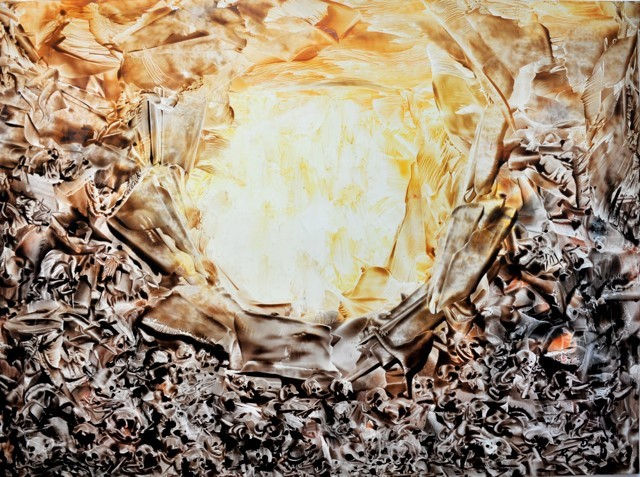
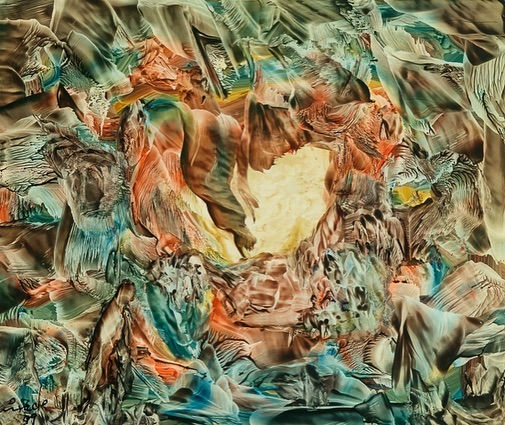
Early critics described his paintings as an “intimate anatomy of reality.” His work does not depict the world as it appears; it dismantles it, revealing its internal tensions—psychological, spiritual, and existential. Landscapes fracture, figures dissolve, and space becomes unstable, suggesting a world experienced not as fixed, but as perceptual and shifting.
This philosophical depth is inseparable from a strong spiritual dimension. As the writer and yogi Ramiro Calle observed:
“We are small beings full of divinity… and in the paintings of Juan Antonio Guirado we find a force that invites us to reconsider our existence.”
Guirado’s engagement with Vedantic philosophy and concepts of inner vision aligns closely with this interpretation. His work is not concerned with representation, but with perception—with what lies beyond the visible.
Why Juan Antonio Guirado Matters Today
Guirado himself articulated this position with striking clarity:
“Human evolution is now at a precipice created by itself…We are in a race between self-discovery and self-destruction.”
Written decades ago, this statement now reads with unsettling immediacy.
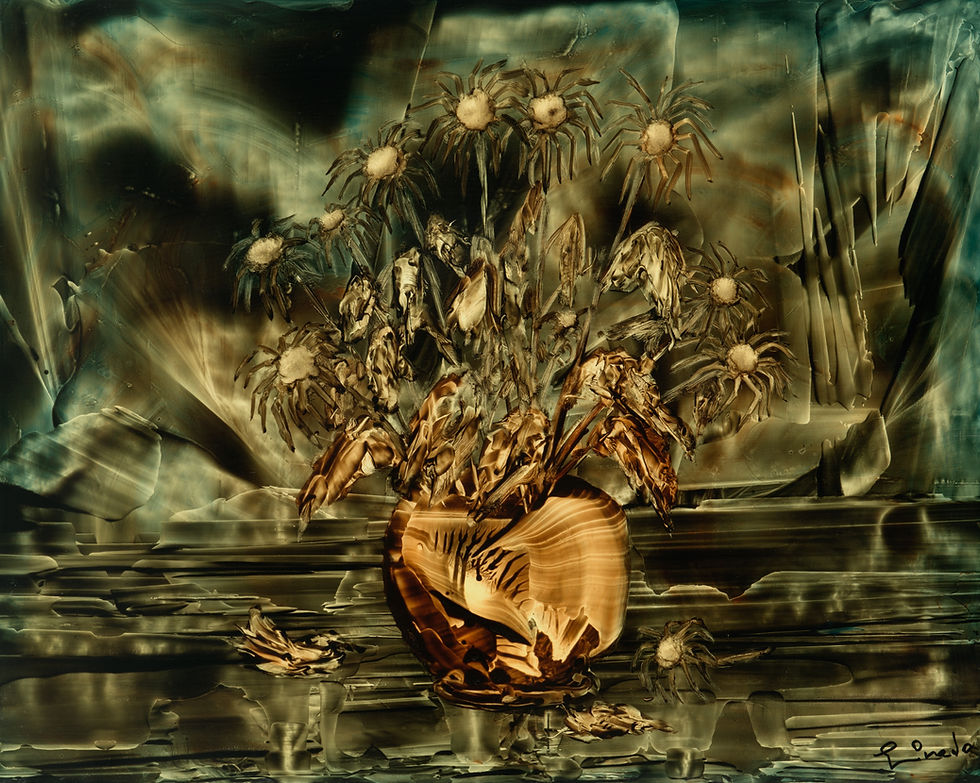
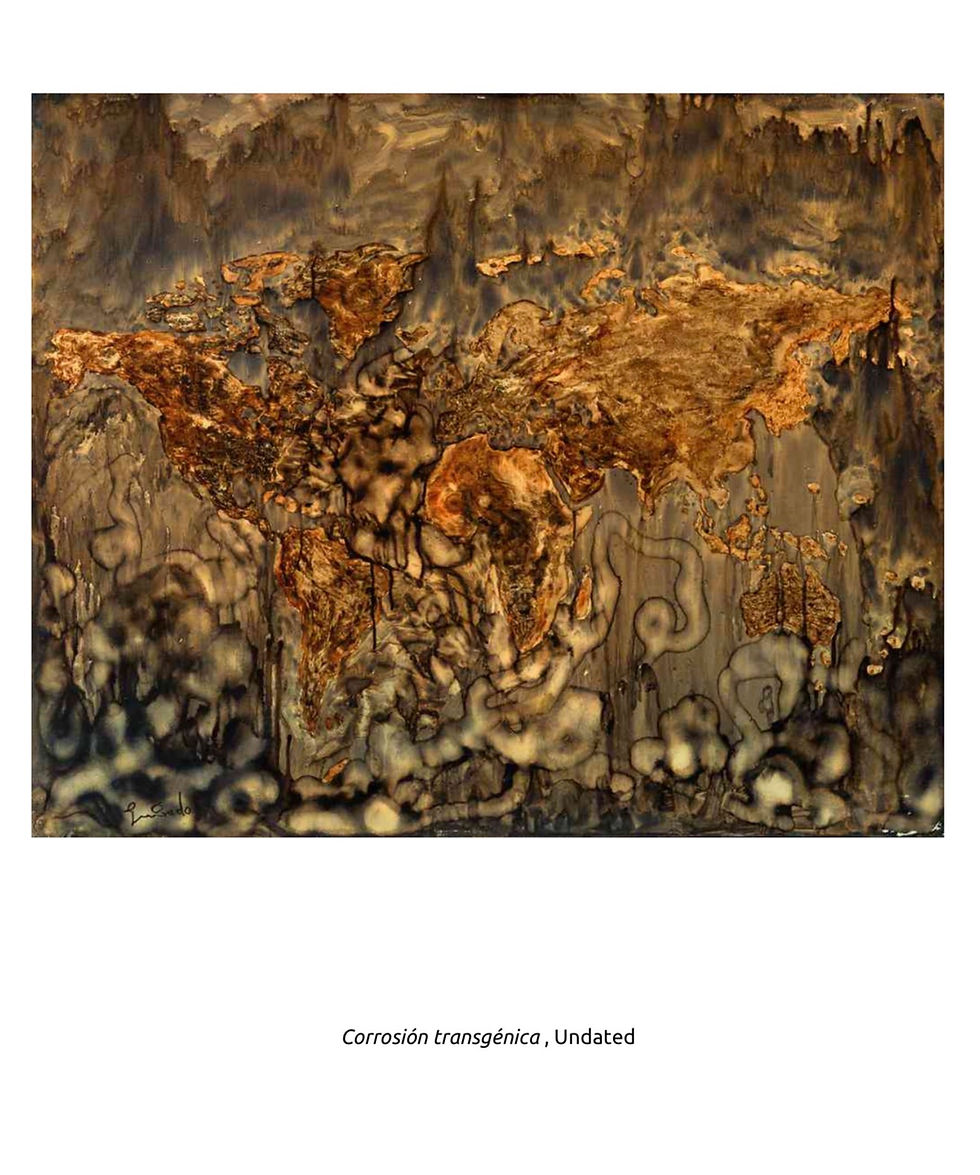
His work engages directly with the defining conditions of our time—environmental collapse, technological acceleration, and the instability of human systems—long before these became central to global discourse. Following his return to Spain in 1983, he entered a phase he described as Ambientalismo (Environmentalism), producing works that explored the consequences of human activity on the natural world.
At the same time, his work maintains a strong connection to broader art historical traditions—from the spiritual abstraction of Wassily Kandinsky to the psychological intensity of Francisco Goya and the symbolic complexity of Hieronymus Bosch—while resisting full alignment with any single lineage.
Art Historical Context and Institutional Recognition
Institutional recognition further reinforces this position. Guirado’s work is included in the collection of the foundation established by Cesáreo Rodríguez-Aguilera, now associated with the University of Jaén, where his work has been presented alongside major Spanish artists, including Pablo Picasso and Joan Miró. In this context, he has been recognised as a significant painter emerging from the region of Jaén, further situating his work within a broader Spanish and international canon.
To revisit Guirado today is not simply to look backward, but to recognise a body of work that anticipated the conditions we now inhabit.
Conclusion: A Timely Re-Emergence
Intrarealism may not have returned as a defined movement. But its concerns—perception, instability, and the search for deeper reality—have unmistakably resurfaced.
And in this renewed context, Guirado’s work no longer appears marginal.
It appears prescient. In this renewed context, Juan Antonio Guirado’s relationship to Intrarealism no longer appears marginal—it defines a framework through which contemporary art can be reinterpreted.

Sea of Fire 
Tunnel of light / Third Eye 
Energy Vibration
Discover the Work
Juan Antonio Guirado’s work will be presented as part of the exhibition Dialogues on the Knoll, 918 West Knoll Drive, West Hollywood, CA curated by Kipton Art.
Further details, available works, and enquiries can be accessed through the exhibition and artist pages.
Explore other signature curated works and the Collectors Access portforlio released by the Guirado Estate for sale at TheGuiradoCollection.com


Comments