
From It Girl to Art Estate Heiress: My Journey into Inheriting an Art Legacy, Losing a Father, and the Revival of Juan Antonio Guirado’s Visionary Work

Updated: Oct 2, 2025

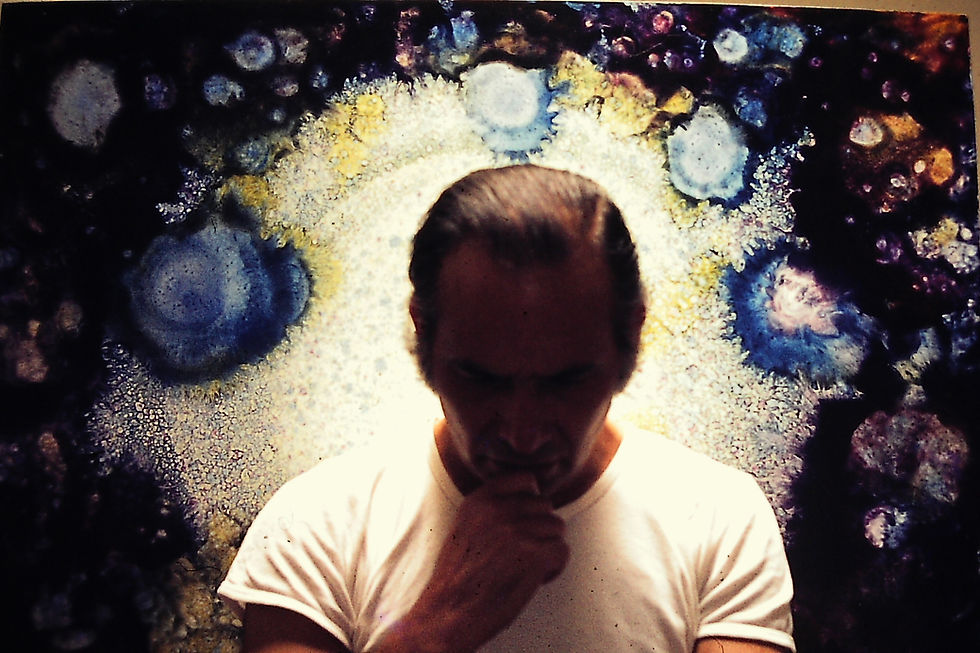
When my father — the Spanish visionary painter Juan Antonio Guirado — passed away in 2010, I inherited far more than a collection of paintings. I inherited a legacy I barely understood — and a journey that would change the course of my life.
A Complicated Bond
My relationship with my father was… complicated. He and my mother separated when I was seven, and we lost touch until I was an adult in the late ’90s. Around 1998, we reconnected. He left his second wife, returned to my mother — his first and true love — and acknowledged the mistakes he had made. Surprisingly, I carried no resentment. I was simply grateful to have my family reunited. He even walked me down the aisle at my wedding in 2007 — something I’d once thought impossible.

We enjoyed summer visits in London or Spain, polite exchanges on birthdays and Christmas, but our bond remained fragile. Still, I had inherited much of his essence: his joie de vivre, his artistic spirit, his fascination with metaphysics, half of his face, and — of course — a fiery Spanish temper. Genetics, it seems, ignore upbringing.
The Call That Changed Everything
In 2010, the news came: lung cancer. My mother and I flew to Mojácar, Spain, to find him in the late stages of illness. We stayed for several weeks until he insisted we return home and visit after his treatment. That treatment never came. Three days before his first chemotherapy session, he passed away.
No Time to Grieve - Inheriting an Art Legacy
In Spain, burial must take place within 24 hours — a remnant of medieval times to prevent decay in the heat. By the time we reached Mojácar, the funeral was over. I was taken straight to the funeral parlour to sign for his ashes. An urn was placed in my hands. Along with his ashes, I inherited his artwork — and whatever was left in his bank account.
I had just 24 hours to access his studio and decide what to take. My Spanish had faded over the years, so I relied on my father’s dear friend Paco, who kindly helped with translation and stored some of the belongings.

Inside the Studio
I didn’t know what I was looking for, but instinct took over. The studio was a time capsule: jars of paintbrushes, tubes of oil paint mid-squeeze, spare canvases stacked against the wall, palette knives stained with colour. The smell of turpentine hung in the warm Andalusian air.
On his bookshelves, I found meticulously kept ledgers, exhibition catalogues, and press clippings spanning a career that began in the mid-1960s in Sydney, Australia. He had never shared this history with me. When I’d asked about his career, he’d shrug and say, “I’m a famous painter.” I thought it was a joke. My mother believed he had always struggled as an artist. The truth — which I would later uncover in full — was that in the 1970s, he exhibited internationally more than any other Spanish painter of the decade.
There were hundreds of oil paintings in his signature abstract surrealism style, created on the special photographic paper he favoured, alongside a few canvases. A pile of stunning impressionist landscapes, rendered with thick oil paint and palette knives, depicted the rugged Andalusian mountains surrounding Almería and his home in Jaén—his bread-and-butter paintings that helped pay the bills, primarily for tourists and locals.

La Trauma 2002 
Encuentro Visioario Oil on paper, 1998 
Apocalypse Oil on paper 2004, Kaleidescope 2002 Kaleidescope 3 2003 Tabernas Undated oilon cardboard 52.5 x 70.5 cm / 20 2/3 x 27 3/4 in Belleza inarmónica 1996 oilon Granada Toreodor 
Carmen la casita 
Zarzales de Coral
Among these works was an unfinished portrait of my mother, begun from a photograph of her in her 20s during their time in Australia; she had always been his muse, as well as my own childhood likeness. Additionally, vibrant spray ink paintings and sketches of landscapes, along with portrait studies spanning his career, filled the space. What I would later discover was that more canvases were hidden locally, and I would have to confront some not-so-friendly acquaintances of my father to retrieve them.

Unexpected Treasures
There were beautiful art books on his favourite painters, collected over decades. And, surprisingly, bullfighting magazines — yes, they exist in Spain. At 18, my father trained to be a toreador. In the 1940s and ’50s, bullfighters were Spain’s rock stars. Thankfully, he realised he couldn’t bring himself to kill a bull and returned to painting. That decision led to a series of bullfighting oil paintings and studies that became popular in Jaén and Mojácar. Personally, I abhor bullfighting, so I’m grateful for his change of heart.
The most valuable finds were his press clippings, original typed essays by critics and art scholars, and exhibition catalogues that tracked his career year by year.


The Moment It All Changed
Sitting in that sunlit room, reading reviews from 1968 in Australia through to 2008, I realised I wasn’t holding the work of a “struggling artist.” I was inheriting an art legacy, holding the archive of a man whose career spanned continents and decades — a legacy the world had almost forgotten.
The Revival of Juan Antonio Guirado’s Vision
The journey ahead is daunting yet exhilarating. I am determined to revive my father's legacy. His unique vision and the style he coined, 'Intrarealism', deserve to be celebrated. I envision exhibitions that showcase his work, allowing a new generation of collectors and art enthusiasts to experience his artistry.
I often wonder, how can I best honour his memory? How can I ensure that his contributions to the art world are not lost? These questions fuel my passion. I am committed to preserving his unique vision and ensuring it remains accessible to all.


Comments